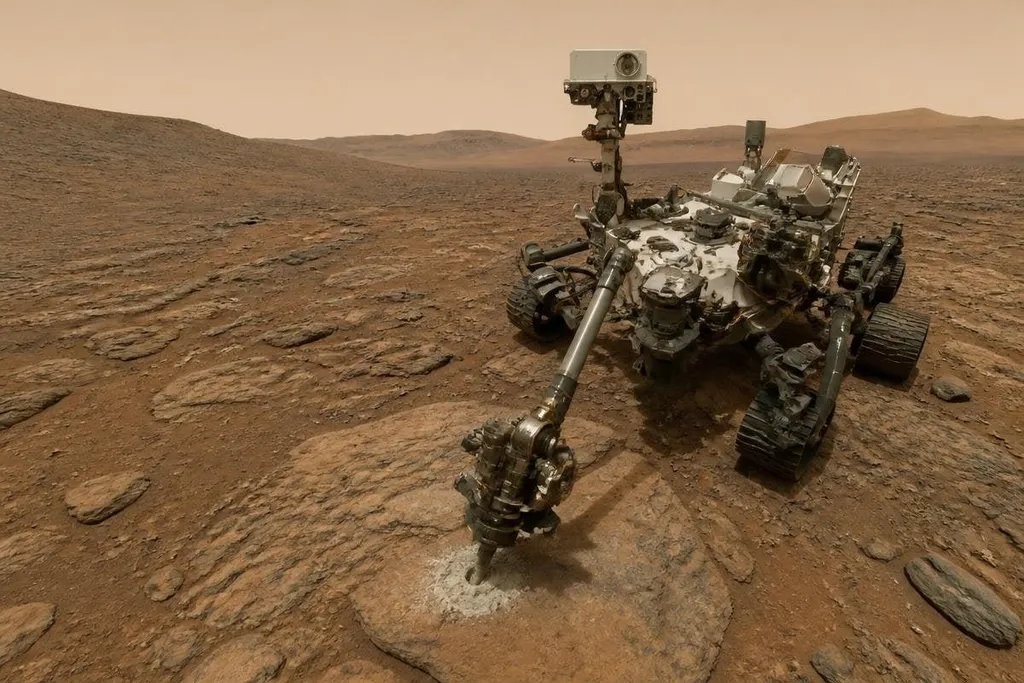
NASA’s Perseverance rover landed on Mars in February 2021. Its job includes studying rocks, recording the ground around it, and storing samples that may later reach Earth.
That work shows what robots can do well in the search for life beyond Earth: reach hard places and collect evidence without putting people at risk.
Quick read
- Mars rovers can study rocks, soil, and weather from the surface.
- Ice moons may need drilling, swimming robots, or small landers.
- A possible sign of life needs checks from more than one test.
What robots can test
A robot can carry cameras, spectrometers, drills, and other sensors. A spectrometer reads how light interacts with a material, which can help identify minerals or carbon-based compounds.
The useful result is not a single strange reading. A robot needs to test the same sample in more than one way, record its location, and send the data back with enough detail for scientists to check the work.
Mars gives engineers a nearby place to test this process. Curiosity has worked on Mars since its landing in August 2012, while Perseverance studies a different area and stores rock cores for possible return. The two missions show why robot design depends on the job: one rover may focus on long-term surface work, while another gathers samples for later study.
A robot can also look for signs that life changed its surroundings. It might check the chemistry of a rock, the shape of a mineral layer, or the gases near the ground. None of those results proves life on its own. Natural processes can produce many of the same signals.
The hard places come next
Mars is cold, dry, and exposed to radiation, but its surface is easier to reach than the oceans thought to exist below the ice of Europa or Enceladus. A lander sent to an ice moon may need to survive a rough landing before it can even begin its work.
That creates several robot designs. A drill could cut through ice. A small underwater robot could move through an ocean after a lander reaches it. A surface rover could study cracks where material from below may have reached the top.
Europa Clipper launched in October 2024 to study Europa during repeated flybys. It is not a life-detection rover, and it will not land on the moon. Its measurements can still help engineers decide which places deserve a later landing mission.
The search also depends on communication. A robot far from Earth may have to wait minutes or longer for instructions, so its software must handle routine choices on its own. It needs to spot a safe route, choose a sample, and protect its instruments when conditions change.
A robot can collect a promising sample, but one reading can't prove that life exists. Space robotics reporting can tie that claim to a named mission, instrument, and test result before the next section looks at the limits of robot evidence.
Why a robot cannot settle the question alone
A sensor reading can be wrong because of dust, radiation, a dirty instrument, or a chemical process that has nothing to do with biology. A robot also has limited power, storage, drilling depth, and time near each target.
The strongest case would combine several kinds of evidence. A sample could show an unusual chemical pattern, a structure linked to living processes, and a result that survives repeat testing. Scientists would still need to compare those findings with non-living explanations.
Sample return helps because Earth laboratories can use larger instruments than a rover can carry. It also adds risk: the sample container must stay sealed, the landing system must work, and researchers must prevent contamination in both directions.
I’d trust a robot to find the right evidence before I’d trust it to announce life from one sensor result.
A practical check before backing a mission
Use this checklist when you read a claim about robotic life detection:
- Name the target: Check the planet, moon, crater, or ice region involved.
- Check the instrument: Find out what the sensor measures and what it cannot measure.
- Separate signs from proof: A chemical clue may have a non-living cause.
- Look for repeat tests: One reading carries less weight than results confirmed by another method.
- Ask about samples: See if the plan keeps material on site or sends it to Earth.
- Mark the unknowns: Note the parts that depend on a future landing, drill, or return flight.
Robots will likely reach places people cannot, but the final claim will still depend on careful tests and open data. The next useful question is not “Did the robot find life?” It is “Which result would survive a second test?”